

Art: Its Contemporaneity, Its Place in History, and History Within Art.

What is art if not a mirror held up to each era? Works of art are never born outside of time: they embody the hopes, crises, ideals, and upheavals that shape societies. Yet they do more than simply reflect, they invent, transform, and challenge. Art is both memory and movement: it writes history while also drawing nourishment from it.
As the poet Theodore Huebner Roethke expressed: "Art is the means we have of undoing the damage of haste. It's what everything else isn't". This thought resonates powerfully in our contemporary world, where speed, efficiency, and immediacy often guide our lives. Haste, in our decisions, our relationships, our cultural consumption, even our relationship to information, leaves behind invisible scars: superficiality, misunderstanding, a loss of meaning.
Art, by contrast, moves against the current. It invites us to slow down, to contemplate, to feel. It opens a space of repair, where reflection can replace automatism, and where complex emotions can finally take form. Whether in a painting by Rothko, drawing us into a meditative experience through simple fields of colour, or in a sculpture by Giacometti, condensing in a fragile silhouette all the solitude of modern man, art allows us to suspend time. This is why art is inseparable from history. Each work testifies to its moment, but also to the desire to go beyond that moment. From Delacroix immortalising the revolutionary fervour of 1830 in La Liberté guidant le peuple, to Picasso crying out the horror of war in Guernica, art reminds us that beauty is not limited to ornament: it is also consciousness, memory, and repair. Thus, to enter the history of art, from medieval frescoes to digital creations and NFTs, from Art Deco to contemporary installations, is to embrace this double movement: to understand the societies that came before us, but also to discover how art still helps us today to heal the wounds of a hurried world and to rediscover our present and prepare our future.
History in Art, Art in History.
Defining the contemporary era can be challenging, but arguably (at least from a french-centric perspective), we can set this period within a range starting from the French Revolution to the advent of the first NFT art, which signs, most likely, the beginning of a new period. The storming of the Bastille in 1789 and the Serment du Jeu de Paume (Tennis Court Oath) marked not only a political rupture but also the emergence of a new cultural consciousness: artists became witnesses to revolutions, and their works started reflecting the hopes and fractures of societies in transformation. Between 1789 and nowadays, there have been 13 successive political regimes, with 7 occurring only in the first 30 years. Therefore, the boundaries between political upheavals and artistic innovation became deeply intertwined. This intensify the complexity we can have when defining the contemporary era, also in matters of art movements.
The temporality of art in the light of history is then divided in a multitude of duality. Artistic periods are not linear but complex, involving multiple intersecting timelines. These timelines reflect the intricate relationships between art movements and their historical contexts, showcasing how various influences shape artistic expression.
Consider the example of Jean-Louis David, a prominent figure in Neoclassicism. His work is deeply linked to the revolutionary and Napoleonic turmoil. However, this artistic temporality does not mirror that of its students. For instance, Antoine-Jean Gros already exhibits a shift towards Romanticism in "Bonaparte Visiting the Plague Victims of Jaffa" (1804), blending political heroism with dramatic elements. A similar example is Anne-Louis Girodet's "Scene of the Flood" (1806), which demonstrates the Romantic style by incorporating lyrical sensitivity and drama while retaining some touches of its era, such as in the baby's sheets, a characteristic of Neoclassicism.

Antoine-Jean Gros, Bonaparte visiting the plague victims of Jaffa, 1804, Paris, Louvre Museum 
Anne-Louis Girodet de Roucy-Trioson, Scene of the Flood, 1806, Paris, Louvre Museum
Furthermore, each artistic period contains internal variations and contradictions, highlighting the diversity of thought and creativity that exists within a single era. This multifaceted nature of art invites deeper exploration and understanding of its evolution over time. Artistic temporality beyond chronology highlights how artists often transcend strict movement boundaries, allowing their works to acquire multiple interpretations across different historical periods. Another example can from architecture and a chefs-d'oeuvre of France: The Arc de Triomphe.
Initially intended to celebrate the military glory of the Empire and to inscribe the figure of the Emperor within a Roman continuity. The sculpture of Napoleon's Triumph (Jean-Pierre Cortot, 1833–1834) embodies this imperial program: the Emperor is depicted as a conqueror, crowned by Victory, in an iconography that directly recalls ancient triumphs. However, the lengthy construction time (over 30 years) altered the meaning of the monument. Completed in 1836, during the July Monarchy, it was enriched with another bas-relief: The Departure of the Volunteers of 1792 (François Rude, 1833–1836). Here, the imagery is entirely different: it is no longer the victories of Napoleon that are glorified, but the patriotic fervour of the French Revolution. Thus, a single monument concentrates two temporalities and two political narratives: that of the Empire and that of the post-revolutionary monarchy. The Arc de Triomphe becomes the perfect example of a work whose meaning cannot be reduced to its initial project, but which crystallises, over the duration of its conception, the changes of regime and the successive rewritings of national history.
Some artists deliberately create work ahead of or outside their contemporary context, demonstrating that art is not confined to the temporal limits of its creation. The founding artists of Impressionism perfectly illustrate this ambiguity of temporality. Often misunderstood and ridiculed, they developed a new mouvement, a new temporality long before it would be acknowledged by time and history. The exposition of 1874 is considered as th founding act of the mouvement. However, artists such as Claude Monet, Berthe Morisot and others, had experimented with this style a decade earlier.

Claude Monet, Bathers at La Grenouillère, 1869, London, National Gallery 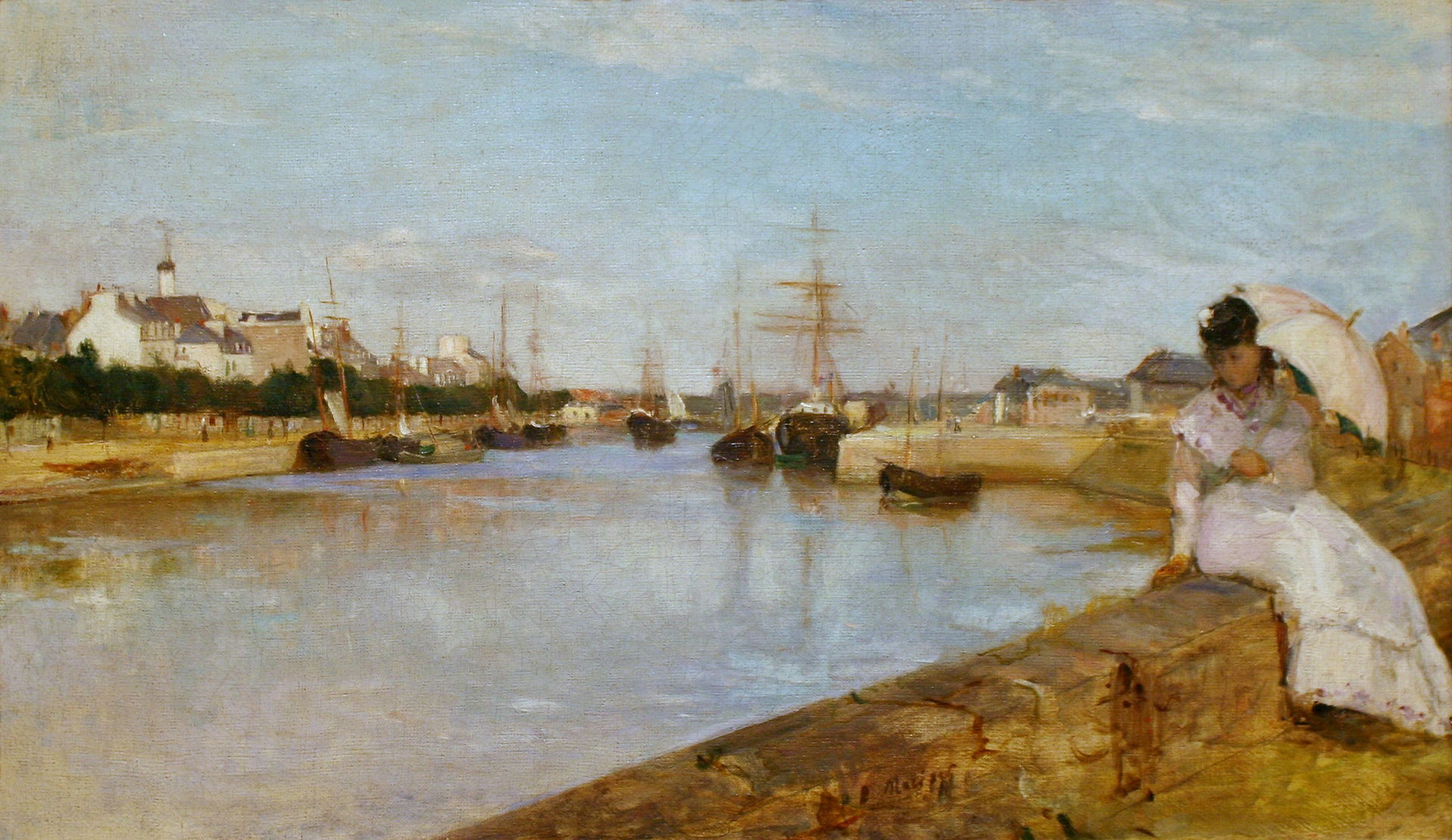
Berthe Morisot, The Harbor at Lorient, 1869, National Gallery of Art, Washington DC 
Frederic Bazille, The pink dress, 1864, Paris, Orsay Museum
This fluidity in artistic expression reveals the complex relationship between time and art, suggesting that the significance of a piece can evolve as it is viewed through various lenses of history.
Art is therefore never frozen.
Its meaning shifts as history moves forward.
To study art is not only to analyse forms and styles but also to trace the dialogue between creation, its time, and ours; between the moment of making and the long afterlife that transforms a canvas, a sculpture, or an object into cultural memory.


